How To Choose A Useful Entryway Organisation Routine For Busy Households
A practical step-by-step guide to how to choose a useful entryway organisation routine for busy households, including preparation, instructions, common issues, tips, and next steps.
How To Choose A Useful Entryway Organisation Routine For Busy Households
A useful entryway organisation routine for busy households turns a chaotic drop zone into a calm, efficient space. This guide helps you create a simple daily system that everyone can follow, even on hectic mornings. It covers how to assess your entryway, choose the right storage, set up a routine, and maintain it with minimal effort. You'll find practical steps, quick solutions for common problems, and advanced tips for long-term success. The focus is on making your entryway work for your family's real-life needs, reducing lost items, and making departures and arrivals smoother.
Fast Answer
- Start by clearing your entryway completely and sorting items into three piles: keep, relocate, and toss. This gives you a blank canvas to design a routine that fits your family's actual needs.
- Choose simple, labeled storage for each family member's daily items, like a cubby or hook, and set a two-minute tidy-up time each evening to reset the space.
Before You Start
- Gather a few large boxes or bags for sorting items as you clear the entryway. Label them 'keep', 'relocate', and 'toss' to make quick decisions.
- Take a photo of your current entryway before you start. This helps you see the clutter objectively and gives you a 'before' image to compare later.
- Measure your entryway dimensions, including wall space, floor area, and door swing. Write these numbers down so your storage choices will fit comfortably.
- Make a list of the main activities that happen in your entryway each day, such as putting on shoes, storing backpacks, or hanging coats. This helps you prioritize storage.
Step-by-Step Instructions
Clear and sort the entire entryway
Begin by removing every single item from your entryway, including coats, shoes, bags, keys, mail, and anything else that has collected there. Place each item into one of three labelled piles: keep, relocate, or toss. Be honest with yourself about what actually belongs in this space. Items that are used daily or weekly and are needed as you leave or return should be kept. Things like shoe polish, old newspapers, or out-of-season accessories should be relocated to a more appropriate storage area. Anything broken, worn out, or unused for over a year should be tossed or donated. Once the floor and surfaces are clear, give the area a quick wipe-down to clean off dirt and dust. This blank canvas will make it much easier to see where each remaining item should go. The check is to ensure every pile is completely empty before moving to the next step, because sorting is the foundation of your new routine.
Define zones for each entryway activity
Think about the main activities that happen in your entryway: arriving with bags, leaving with shoes, grabbing a jacket, and dropping off keys. Create a mental map of your entryway and assign a zone for each activity. For example, the zone near the front door could be for shoes you take off, while a wall hook across from the door is for jackets. A small tray or bowl near the door is perfect for keys and small items. For backpacks or work bags, designate a specific hook or low shelf. It may help to physically mark these zones with tape on the floor or a small sign until everyone gets used to it. The key is to place items where you actually use them, not where it 'looks nice'. This reduces the chance that things get dropped in random spots. After you have defined your zones, go through your 'keep' pile and assign each item to a specific zone. If an item does not fit any zone, put it in the 'relocate' pile.
Select storage that fits your zones
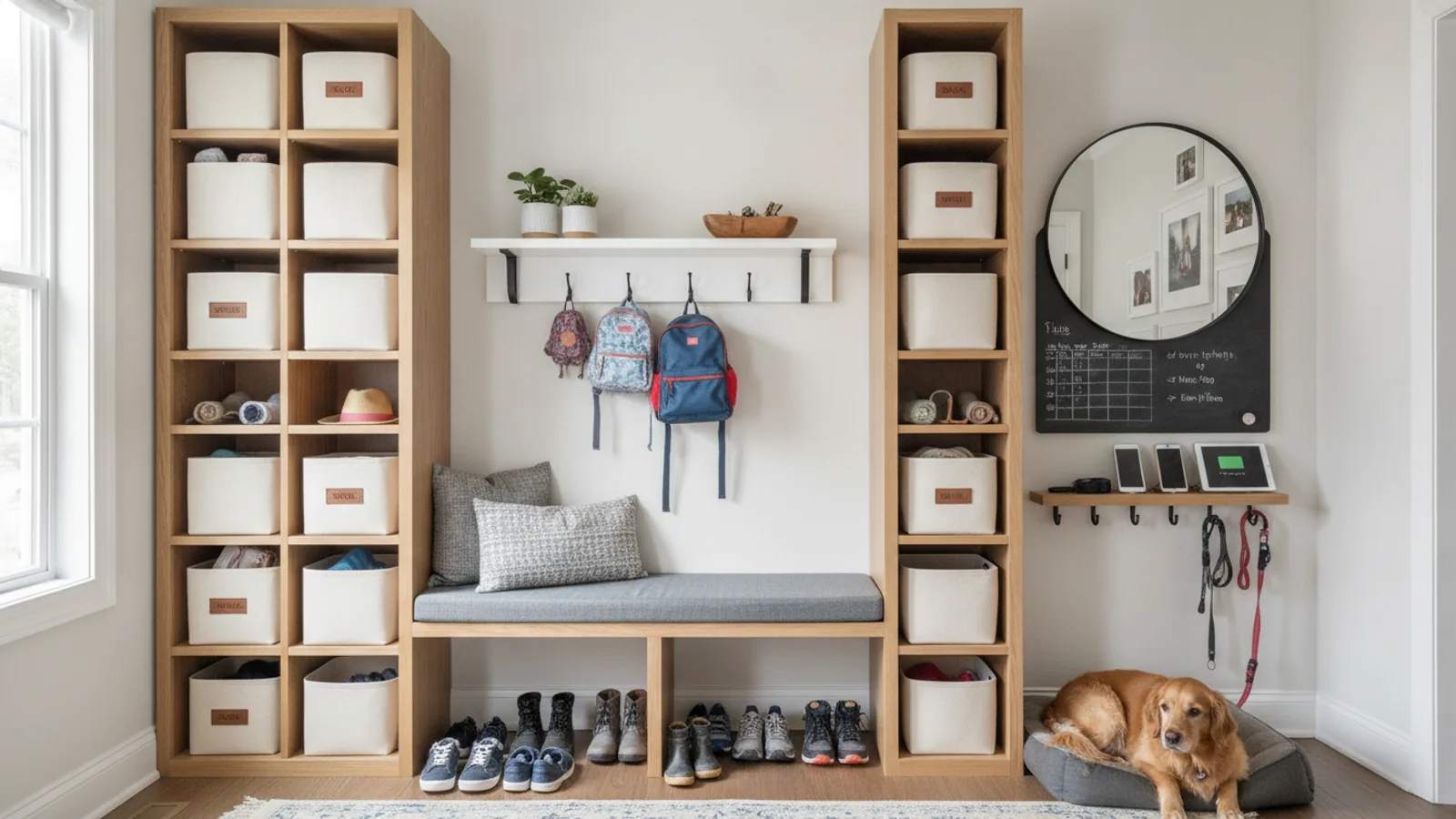
Now that you have defined your zones, choose storage options that fit both the items and the space you measured. For shoe zones, an open shoe bench or a low shelf with baskets keeps shoes easy to reach. If you have many shoes, a tall cabinet with shelves can hold more, but it takes up floor space. For jackets and uniforms, wall hooks at different heights accommodate both adults and children. Add a small table or ledge near the door of keys, sunglasses, and other tiny essentials, and put a small container on it to keep them from rolling off. For backpacks and reusable bags, use large hooks or low bins that can handle weight. If you have bulky items like sports gear, consider storage in a garage or a hall closet, not the entryway. The check is to measure the depth and width of each piece of furniture against your dimensions, and to make sure every item from your 'keep' pile has a designated storage spot. Avoid open shelving if items will be visible and messy, unless you use baskets to hide clutter.
Set up a personal station for each family member
To make the entryway work for everyone, give each person their own designated area. This could be a cubby, a basket, a hook, or a combination. For children, keep their station low enough to reach so they can take charge of their own gear. For adults, a higher spot may be more natural. Place each person's daily essentials in their station, such as their shoes, jacket, bag, and maybe a hat or umbrella. It is important that these stations are not too big, because an oversized space invites clutter. Show each family member exactly where their station is and explain what goes in it. This personal ownership encourages everyone to put things back in the same spot, rather than dropping them anywhere. A practical check is to watch each family member use their station for a week. If they tend to miss the bin or hook, adjust the height or add a small basket on the floor next to the station to catch the overflow.
Create a daily and weekly tidy-up rhythm
A tidy entryway only happens if it becomes a habit. Set a specific time each day for a two-minute tidy-up. For example, every evening before you go to bed, walk through the entryway and put any stray items back into their designated spots. This quick reset prevents items from piling up. Additionally, choose one day per week for a deeper clean. On that day, wipe down surfaces, sweep or vacuum the floor, and check for any items that have accumulated and need to be relocated or tossed. Involve the whole family in these tasks, especially by giving children simple jobs like matching shoes or hanging their jacket. The check is to see if after a week, the entryway looks basically the same at the end of the day as it did in the morning. If not, increase the tidy-up to three minutes or add a second short tidy-up after school or work. This rhythm will become automatic over time, but it needs to be consistent for at least three weeks.
Review and adjust the routine every few weeks
After a month of using your new entryway routine, evaluate how it is working. Look for problem areas, such as shoes piling up by the door, jackets on the floor, or backpacks not being hung. Talk to your family about what is working and what is not. Something that seemed right in theory may not work in practice. For example, the coat hook might be too high for a child, or the shoe basket might be too small for the number of shoes used each week. Adjust the zones, storage, or the tidy-up time if needed. The goal is not to create a perfect system, but to have a routine that the whole household can stick with easily. A practical check is to time how long it takes to get out the door in the morning. If the entryway is still a bottleneck, reassess the flow. This ongoing adjustment is necessary because family needs change, such as a new hobby or a different school schedule. Fine-tuning the routine every few weeks keeps it functional and useful.
Quick Reference
| Situation | Action | Why it helps |
|---|---|---|
| The entryway is cluttered with shoes scattered on the floor every morning. | Place a boot tray or a shallow mat right inside the door and instruct everyone to put their shoes on this tray as soon as they come in. Keep a small stool nearby so people can sit to remove shoes. | This gives shoes a specific landing zone, preventing them from spreading and making it easier to grab them quickly in the morning. |
| Keys and small items like sunglasses are constantly lost in the entryway. | Install a small wall-mounted shelf or a tray near the door, and always put your keys and other small items in that same tray when you come home. Attach a hook for your lanyard above the tray. | Having one fixed place for small essentials eliminates the frantic search for keys and lets you leave the house on time. |
| Backpacks and bags are dumped on the floor just inside the door, creating a tripping hazard. | Install wall hooks at a height that allows you to hang a full backpack, or place a low, sturdy bin beside the door where each family member can drop in their bag. Make this the only spot for bags. | Hanging or containing bags keeps the floor clear and reduces clutter, making the entryway safer and more inviting. |
Common Issues
- The routine breaks down because family members forget to put things away.: Post a visible reminder list near the entryway, such as a small chalkboard or whiteboard, that says 'Shoes, coat, bag, keys'. Also, make the tidy-up time a non-negotiable part of the daily routine, and gently remind each person to check their personal station before leaving the room.
- The entryway becomes cluttered again with items that do not belong there, like random household tools or shopping bags.: Set a rule that only daily-use items can stay in the entryway. Have a 'relocation bin' for anything that sneaks in, and once a week, empty that bin by putting the items in their proper location. This prevents the entryway from becoming a catch-all.
- The storage you chose is too big or too small for the actual items, making it awkward to use.: Before buying any storage, measure the largest item you plan to store, and compare that with the dimensions of the container. For example, for a tall boot, measure the boot's height and width. If the container is too small, it will be frustrating; if too big, it invites clutter. Try to do a 'test fit' by placing the item in the container before committing.
Advanced Tips
- Create a 'launch pad' near the door with a charging shelf for devices like phones and tablets, with a small tray to hold them while charging. This keeps them from getting lost and ensures they are ready to go.
- Use a weekly rotation for items that are not used daily, such as sports gear or library books. Store these in a clearly labelled bin and bring them to the entryway only on the day they are needed.
- Incorporate a monthly 'entryway audit' where you do a quick 5-minute sweep: remove anything that doesn't belong, wipe down surfaces, and check that the zones are still working. This keeps the system from gradually degrading.
Final Checklist
- All entryway items are sorted into 'keep', 'relocate', or 'toss' piles, and the 'keep' pile has a designated home in a zone.
- Each family member has a personal station with labeled storage for their shoes, coat, bag, and small essentials at a height they can easily use.
- You have set a daily two-minute tidy-up time and a weekly deeper clean, and everyone in the household knows their responsibility in the routine.
- You have conducted a one-month review and made adjustments to the zones or storage based on real use, so the routine continues to meet your household's needs.
FAQ
What do I do if my family is resistant to putting things away?
Make the routine as easy as possible. Make sure storage is convenient: hooks at child height, open bins instead of closed cabinets, and a seat to take off shoes. Make it a fun challenge, like a 2-minute tidy-up race, or give each person ownership of their coloured hook or bin. Remind them of the payoff, like easily finding items and leaving quickly. Be consistent and always lead by example. It will become a habit after a few weeks.
How often should I really declutter my entryway?
Aim to declutter lightly every day during your two-minute tidy-up, and do a more thorough declutter once a month. If you notice that items are multiplying, do a quick 15-minute 'entryway audit' to reassess what is really being used. Seasonal changes are a good time to remove out-of-season items, like heavy jackets or swim gear, to keep the space functional.
Can I still use my entryway for storage even if it is really small?
Absolutely. For small entryways, focus on vertical storage, such as wall hooks, shelves, and slim shoe organisers. Use over-the-door fittings for items like scarves or umbrellas. Avoid bulky furniture; instead, opt for a small bench with built-in shoe storage. Keep daily items only, and use a basket for each person if needed. Use the space under the seat for shoes. This way, you maximize the limited area without making it feel cramped.